
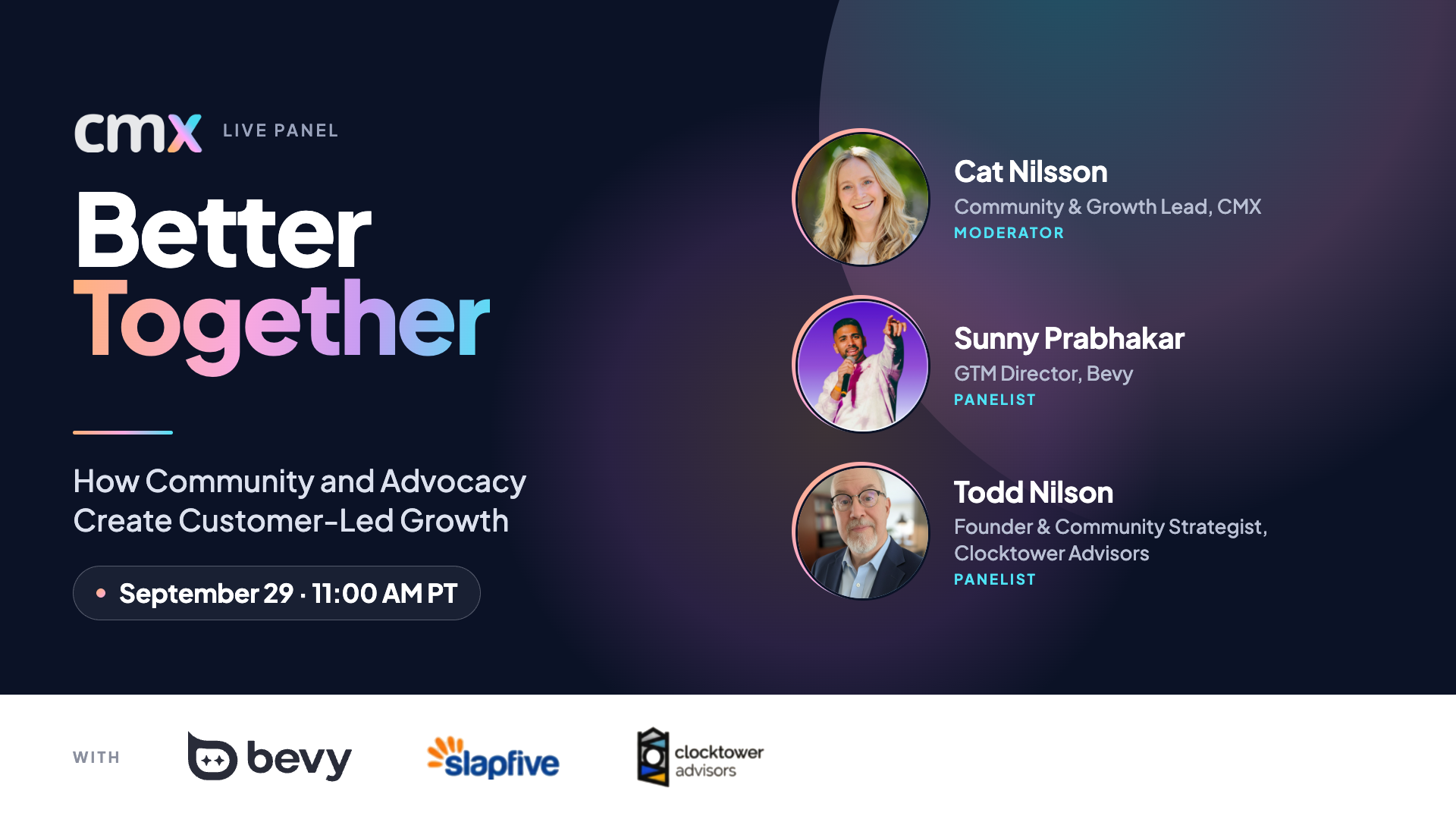
Better Together: How Community and Advocacy Create Customer-Led Growth
Actionable Insights
🤝 Find the Common Goal, Then Work Backward
The biggest barrier between community and advocacy isn't necessarily a lack of data. It's that the two teams are often measured on completely different things.
Jeff, Sunny, and Todd all came back to the same idea: start with the company's actual growth priorities, then figure out how both teams can contribute. Whether the focus is retention, product adoption, expansion, referrals, onboarding, or customer-led pipeline, a shared outcome gives both teams a reason to work together.
Action: Set up a working session with your community and advocacy counterparts. Start by comparing what each team is accountable for, then identify one shared business outcome you can influence together. From there, map the programs, customer behaviors, and data you already have that could help move that outcome.
Measure: Move beyond community and advocacy activity metrics in isolation. Look for the business outcomes you're jointly influencing, whether that's retention, adoption, referrals, pipeline, or another strategic priority.
🔎 Your Community Is Already Telling You Who Your Advocates Are
One of the biggest opportunities discussed was using community behavior to uncover advocates before someone explicitly raises their hand. The people answering questions, helping other members, sharing best practices, attending events, taking ownership of programs, or demonstrating expertise are giving you valuable signals. And the key isn't simply finding your most active members. As Todd put it, look for the people who are helping. Those signals can help advocacy teams proactively identify and nurture potential advocates instead of relying entirely on reactive requests from sales, customer success, or marketing.
Action: Look beyond raw engagement. Identify members who consistently help others, share expertise, demonstrate product knowledge, or contribute in ways that build trust and credibility. Then create a clear path for those members to take on additional advocacy opportunities.
Measure: Track how many community members identified through these behaviors go on to participate in advocacy activities, and which behaviors are most predictive of ongoing advocacy.
💡 Make Advocacy Valuable for the Customer, Too
Perhaps the most important mindset shift from the conversation: advocacy shouldn't just be about what the company can get from its customers.The strongest programs create a two-way exchange of value. Customers get opportunities to build their reputation, showcase their expertise, influence the product, connect with peers, and gain access to people and experiences they wouldn't otherwise have. That changes the relationship from "we need you to do something for us" to "here's an opportunity that benefits you, too." And community can be the place where that happens naturally.
Action: Audit your current advocacy asks. For every opportunity, ask: What's in it for the customer? Look for ways to turn references, testimonials, events, feedback sessions, and other advocacy activities into opportunities for recognition, access, learning, or professional visibility.
Measure: Don't just track how many advocacy activities customers complete. Look at repeat participation, community engagement, referrals, product feedback, and other signs that customers are choosing to stay involved because they're getting meaningful value from the relationship.
The takeaway from Jeff, Sunny, and Todd was pretty simple: community and advocacy don't have to be separate customer experiences.
When community helps identify and cultivate the people who are already showing up, and advocacy gives those people meaningful ways to share their expertise and influence the business, both teams become stronger.
The goal isn't to ask customers for more. It's to create better reasons for them to participate.
Access the Complete Webinar Replay
Actionable Insights
🤝 Find the Common Goal, Then Work Backward
The biggest barrier between community and advocacy isn't necessarily a lack of data. It's that the two teams are often measured on completely different things.
Jeff, Sunny, and Todd all came back to the same idea: start with the company's actual growth priorities, then figure out how both teams can contribute. Whether the focus is retention, product adoption, expansion, referrals, onboarding, or customer-led pipeline, a shared outcome gives both teams a reason to work together.
Action: Set up a working session with your community and advocacy counterparts. Start by comparing what each team is accountable for, then identify one shared business outcome you can influence together. From there, map the programs, customer behaviors, and data you already have that could help move that outcome.
Measure: Move beyond community and advocacy activity metrics in isolation. Look for the business outcomes you're jointly influencing, whether that's retention, adoption, referrals, pipeline, or another strategic priority.
🔎 Your Community Is Already Telling You Who Your Advocates Are
One of the biggest opportunities discussed was using community behavior to uncover advocates before someone explicitly raises their hand. The people answering questions, helping other members, sharing best practices, attending events, taking ownership of programs, or demonstrating expertise are giving you valuable signals. And the key isn't simply finding your most active members. As Todd put it, look for the people who are helping. Those signals can help advocacy teams proactively identify and nurture potential advocates instead of relying entirely on reactive requests from sales, customer success, or marketing.
Action: Look beyond raw engagement. Identify members who consistently help others, share expertise, demonstrate product knowledge, or contribute in ways that build trust and credibility. Then create a clear path for those members to take on additional advocacy opportunities.
Measure: Track how many community members identified through these behaviors go on to participate in advocacy activities, and which behaviors are most predictive of ongoing advocacy.
💡 Make Advocacy Valuable for the Customer, Too
Perhaps the most important mindset shift from the conversation: advocacy shouldn't just be about what the company can get from its customers.The strongest programs create a two-way exchange of value. Customers get opportunities to build their reputation, showcase their expertise, influence the product, connect with peers, and gain access to people and experiences they wouldn't otherwise have. That changes the relationship from "we need you to do something for us" to "here's an opportunity that benefits you, too." And community can be the place where that happens naturally.
Action: Audit your current advocacy asks. For every opportunity, ask: What's in it for the customer? Look for ways to turn references, testimonials, events, feedback sessions, and other advocacy activities into opportunities for recognition, access, learning, or professional visibility.
Measure: Don't just track how many advocacy activities customers complete. Look at repeat participation, community engagement, referrals, product feedback, and other signs that customers are choosing to stay involved because they're getting meaningful value from the relationship.
The takeaway from Jeff, Sunny, and Todd was pretty simple: community and advocacy don't have to be separate customer experiences.
When community helps identify and cultivate the people who are already showing up, and advocacy gives those people meaningful ways to share their expertise and influence the business, both teams become stronger.
The goal isn't to ask customers for more. It's to create better reasons for them to participate.
Upcoming events
CMX Circuit Tour: Experience the CMX community IRL


This fall, CMX is bringing that experience to cities across the U.S. Whether you’re a longtime CMX member or brand new to the community, there’s a place for you on the Circuit.

CMX Summit 2027
The community industry's flagship event is coming back. CMX Summit brings together the world's leading community professionals for two days of honest conversation, tactical depth, and the kind of connections that actually stick.
