
The Hidden Cost of Community Platform Fragmentation for Enterprise Teams
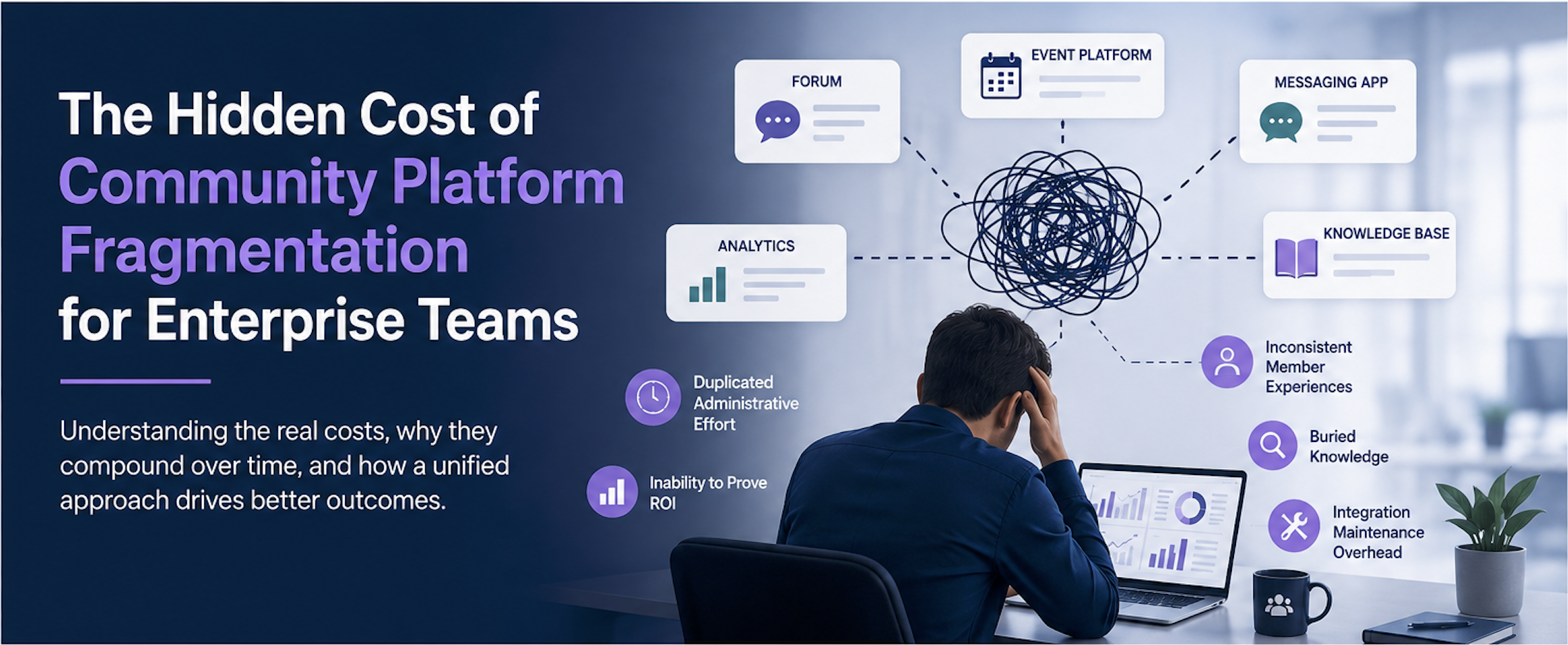
Community platform fragmentation occurs when an organization manages its community program across multiple disconnected tools, such as a separate forum, event platform, messaging app, and knowledge base. This creates data silos, duplicated workflows, inconsistent member experiences, and difficulty measuring the overall impact of community. Enterprise organizations are particularly susceptible because community programs often grow organically, with different teams adopting different tools over time.
The hidden costs of fragmented community tools include duplicated administrative effort across platforms, inability to produce unified engagement data for leadership reporting, inconsistent member experiences that reduce participation, buried knowledge that members cannot find, and integration maintenance overhead. These costs compound over time and make it increasingly difficult for community teams to prove the business value of their programs.
Introduction
Most enterprise community programs did not start out fragmented. They grew that way.
A team launched a forum to handle product questions. Someone else set up an event platform to manage user group meetups. Slack channels multiplied to fill the gaps. A knowledge base appeared somewhere. Before long, the community existed across four or five separate systems, each with its own login, its own data, and its own member experience.
The result is a program that feels bigger than it actually functions. Community leaders spend hours each week toggling between tools, pulling reports that never quite line up, and watching members struggle to find answers they already have. The program delivers real value. It just cannot prove it.
This post names the real costs of running an enterprise community on disconnected tools, explains why those costs matter more now than they did three years ago, and makes the case for a different approach. If you are responsible for a community program that has outgrown its toolset, this is the framework you need to bring to your leadership team.
Why Enterprise Community Programs End Up Fragmented
Fragmentation is not a planning failure. It is what happens when community programs grow faster than the organizations supporting them.
The first tool usually arrives to solve an immediate problem. A surge in product questions leads someone to set up a forum. An in-person user group needs registration management, so an event platform gets added. Customer success wants a Slack workspace for high-touch accounts. Marketing wants community-generated content indexed by search engines. Each decision makes sense in isolation. None of them were made with a unified system in mind.
According to Zylo's annual SaaS Management Index, the average enterprise organization uses 291 SaaS applications, and a meaningful share of those are redundant or duplicative tools solving problems that a consolidated platform could address. Community technology stacks are a prime example of this pattern. What begins as one tool becomes three, then five, then a configuration that no single person fully understands.
The problem compounds when community programs scale. Adding a second user group chapter, a new region, or a new product line multiplies the tool complexity. Each new program element needs to fit into a toolset that was not designed for it, and the integration work required to hold everything together absorbs time and budget that should be going toward member engagement.
By the time an organization recognizes the fragmentation problem, the technical debt is significant. Data is scattered. Processes are inconsistent. And the community leader charged with running the program is spending as much time managing tools as managing community.
The Five Real Costs of Running Community on Disconnected Tools
Fragmentation creates costs that do not always appear in a budget line. They show up in wasted hours, missed opportunities, and strategic limitations that prevent community programs from reaching their potential.
1. Operational Drag That Grows With Your Program
Every tool in a fragmented community stack requires its own administration. Community managers maintain separate user lists, moderate separate content environments, configure separate notification systems, and pull separate reports. A task that should take twenty minutes on a unified platform takes an hour across three.
According to The Community Roundtable's State of Community Management research, the median community team consists of just two to three full-time employees, even for programs serving tens of thousands of members. When a team that small is divided between five systems instead of one, the operational math becomes punishing. The time available for actual community work, including member engagement, content strategy, program development, and event planning, shrinks with every additional tool added to the stack.
Operational drag also makes scaling harder. Adding a new chapter, a new event series, or a new product community requires replicating the same fragmented setup in a new context. The work does not get easier as the program grows. It gets harder.
2. Data Silos That Make ROI Impossible to Prove
Fragmented tools produce fragmented data. A member's forum activity lives in one system. Their event attendance lives in another. Their knowledge base contributions live in a third. No tool sees the whole picture, which means no tool can produce a complete view of member engagement.
This is the root cause of what community leaders describe as the hardest part of their jobs: proving community ROI to executive leadership. Research from Harvard Business Review on measuring the return of customer engagement programs consistently finds that the absence of integrated data, not the absence of community value, is why engagement programs fail to earn executive recognition. Community leaders know their programs are working. They cannot show it in numbers that a CFO finds compelling.
Forrester's Total Economic Impact methodology, which has been applied to quantify the value of mature community programs, identifies measurable impact across four categories: cost savings from support deflection, revenue impact from retention and expansion, productivity gains from faster onboarding and knowledge access, and strategic value from customer advocacy and product feedback. Generating evidence across all four categories requires connecting community engagement data to CRM records, support tickets, and product usage data. That connection is only possible when community data comes from a single system with native integrations. A fragmented toolset makes it structurally impossible.
3. Member Experience Degradation That Erodes Participation
From a member's perspective, a fragmented community program is a disconnected experience. They register for an event in one place, participate in a discussion in another, search for an answer in a third, and receive notifications from all three systems independently. There is no single profile that reflects their full participation history. There is no unified feed that shows them everything relevant to their interests. Every transition between tools is a moment where they might not return.
Forrester's research on digital friction documents how users navigating multiple disconnected systems experience significantly higher task abandonment rates compared to those using unified experiences. Each additional login, context switch, or platform transition is a measurable drop-off point. In community programs, this dynamic appears as declining event attendance from forum members, low cross-participation rates between community areas, and members who engage sporadically rather than building a sustained relationship with the program.
The member experience cost of fragmentation is also a retention cost. When members have a fragmented experience, they are less likely to describe themselves as part of a community and more likely to describe themselves as occasional users of a support resource. That distinction matters for churn. Members who feel genuinely connected to a community are more likely to renew, expand, and advocate. Members who feel like they are using a collection of disconnected tools are not.
4. Knowledge Buried Where No One Can Find It
Community programs generate valuable knowledge continuously. Forum discussions answer product questions. Events surface best practices. Members share configurations, workarounds, and use cases that the company's documentation team would never have the resources to produce. This knowledge has genuine business value. In a fragmented environment, it is nearly impossible to access.
When forum content, event recordings, and knowledge base articles live in separate systems with no shared search layer, members cannot find the answers that already exist. They ask the same question that was answered six months ago in a different tool. They contact support when the solution is in a forum thread they never saw. They skip an event because they did not know it existed. Each of these missed connections represents a failure to deliver on the core promise of community: that the collective knowledge of the group is available to everyone in it.
David Spinks, author of "The Business of Belonging" and one of the most respected voices on enterprise community strategy, has written and spoken extensively about the operational challenge of maintaining quality and consistency across distributed community programs. He argues that the biggest scaling problem for enterprise communities is not engagement or content. It is the infrastructure that makes knowledge findable and consistent across every part of the program. Fragmented tools are fundamentally incompatible with that goal.
5. Integration Maintenance That Eats Budget and Attention
Holding a fragmented community stack together requires integration work. Tools need to pass data to each other. When a member attends an event, that data should appear in the forum. When a forum question gets answered, that answer should surface in the knowledge base. When a member changes their email address, that update should propagate across every system.
In practice, these integrations are expensive to build and fragile to maintain. They break when vendors release updates. They require ongoing monitoring. They create security review overhead because each integration is a potential vulnerability. And they absorb engineering time and budget that most community teams do not control.
The integration cost is not just financial. Every integration is a dependency, and every dependency is a point of failure. When a critical integration breaks, the community leader finds out when a member reports a problem, not when a system alert fires. The result is reactive firefighting that could have been avoided entirely with a unified system that does not require integration in the first place.
Why This Problem Is Harder to Ignore in 2026
Three forces have converged to make community platform fragmentation a more urgent problem than it was three years ago.
The first is AI. Community platforms with AI built into their core architecture can answer member questions from existing content, recognize and reward contributions automatically, and surface emerging issues before they escalate. Platforms that are not AI-native cannot deliver these capabilities without complex third-party integrations, and those integrations rarely work as well as native implementations. As the gap between AI-native and legacy platforms widens, the cost of staying on a fragmented toolset increases.
The second is executive scrutiny of community investment. In a business environment where every department must justify its budget, community programs that cannot produce credible ROI data are vulnerable. Fragmented tools make that data structurally unavailable. Community leaders running programs on disconnected platforms are at a permanent disadvantage in budget conversations compared to those with a unified analytics layer.
The third is the complexity of enterprise community programs themselves. Community programs are no longer simple forum installations. They include global event series, regional user group chapters, advocate programs, customer education journeys, and AI-powered knowledge systems. Managing that complexity across five disconnected tools is not sustainable at enterprise scale. The programs that will grow and earn strategic investment are the ones built on infrastructure designed to support them.
What a Unified Community Platform Changes
A unified community platform does not just reduce the number of tools. It changes what is possible.
When forums, events, user groups, AI knowledge search, and analytics exist in a single system, member data is complete and connected. A member who attends an event, contributes to a forum discussion, and searches for an answer is recognized as the same person in every context. Their engagement history informs how the platform serves them next. Their activity feeds the analytics layer that allows community leaders to demonstrate business impact.
When community knowledge is unified, AI can search across everything. A question asked in the forum can surface answers from event discussions, knowledge base articles, and previous forum threads. Members get better answers faster. Community teams spend less time responding to questions that have already been answered. Support tickets that would have been opened instead get resolved in community.
When event and community data live in the same system, the program becomes more coherent from the member's perspective. Attending an event deepens their forum engagement. Their forum contributions make them visible candidates for speaking opportunities. Their advocacy actions are visible to the community team without a manual cross-referencing process.
The operational benefit for community teams is significant. Managing one platform instead of five means that administrative time decreases, reporting becomes straightforward, and the community leader can spend more time on the work that actually builds community rather than the work that holds the toolset together. For a two or three person team managing a program of tens of thousands of members, that shift in how time is spent is the difference between a reactive support function and a proactive community program.
Frequently Asked Questions
What is community platform fragmentation? Community platform fragmentation occurs when an organization manages its community program across multiple disconnected tools, such as a separate forum, event platform, messaging app, and knowledge base. This creates data silos, duplicated workflows, inconsistent member experiences, and difficulty measuring the overall impact of community. Enterprise organizations are particularly susceptible because community programs often grow organically, with different teams adopting different tools over time.
How does using multiple community tools affect member experience? Members of a fragmented community program must navigate separate logins, separate notification streams, and separate content environments depending on what they want to do. This fragmented experience increases the effort required to participate and reduces the sense of belonging that sustains long-term engagement. Forrester research on digital friction finds that users navigating multiple disconnected systems experience significantly higher task abandonment rates than those using unified experiences. In community terms, this shows up as lower cross-participation rates, declining event attendance from forum members, and members who engage sporadically rather than building a sustained relationship with the program.
What are the hidden costs of managing community across disconnected platforms? The hidden costs of fragmented community tools include duplicated administrative effort across platforms, inability to produce unified engagement data for leadership reporting, inconsistent member experiences that reduce participation, buried knowledge that members cannot find, and integration maintenance overhead. These costs compound over time. A community team spending extra hours each week managing five tools instead of one is not just losing time. It is losing the time that could have gone into engagement strategies, content programs, and member development that would have produced measurable business outcomes.
Why do enterprise community teams end up with fragmented tools? Fragmentation is typically not a deliberate choice. It happens when community programs grow faster than the organizations supporting them. A forum gets added to handle product questions. An event platform appears when the first user group needs registration management. Slack fills the gap for real-time communication. Each decision makes sense in the moment. None of them were made with a unified architecture in mind. By the time the fragmentation becomes a problem, the technical debt is significant and the cost of change feels daunting.
How does tool fragmentation make it harder to measure community ROI? When community activity is spread across multiple platforms, engagement data lives in separate systems with no shared member profile or unified analytics layer. Community leaders cannot connect a member's forum activity to their event attendance, knowledge contributions, or product usage without manual data stitching. This makes it nearly impossible to build a credible ROI narrative for executive stakeholders, because the data required to connect community engagement to retention, support deflection, or product adoption simply does not exist in one place. The problem is not that community lacks value. The problem is that fragmented tools prevent community teams from proving the value that already exists.
What is the difference between a unified community platform and a collection of point solutions? A point solution addresses one specific community function, such as forums or event management, and requires integration with other tools to cover the full range of community needs. A unified community platform combines forums, events, user groups, AI knowledge search, engagement automation, gamification, and analytics in a single system with a shared data layer, shared member profiles, and native integrations. The practical difference is that a unified platform produces complete engagement data, consistent member experiences, and operational efficiency that a collection of integrated point solutions cannot reliably deliver. The integration seams between point solutions are permanent sources of data loss, maintenance overhead, and member experience degradation.
See How Bevy Supports Enterprise Community Programs
Bevy is the enterprise community platform that unifies forums, events, user groups, AI knowledge search, and analytics in one system. If your community program has outgrown its current toolset, we would be glad to show you what a unified platform makes possible.